

Contact Us
Let’s Partner for Your Next Big Presentation
Consult with our Business Advisor
.webp)
Thank you! Your submission has been received!
Oops! Something went wrong while submitting the form.


Investors spend an average of 2 minutes 24 seconds on a pitch deck. That window is down 24% since 2021. In that shrinking attention span, design is not decoration- it is your argument. This guide is for leaders who need to make that window count.
In today's climate, investors allocate an average of two minutes 24 seconds to reviewing your pitch deck. This is down 24% from 2021. In such a tight timeframe, design isn't an afterthought, it's an argument. Here's how leaders can use design to make their case.
Each executive has sat through a pitch that undermined a strong idea due to bad design, inconsistent fonts, overly detailed charts with no apparent visual hierarchy, a template that applies equally well to any brand and any industry. These teams weren't stupid they were missing the design expertise needed to communicate effectively.
Poor design and content delivery cost companies far more than just hours spent creating PowerPoint slides. This manifests in the lasting impression made when meeting potential partners or the board of directors.
The reason why it's wise to hire PowerPoint presentation designers to manage this challenge is because the question at hand isn't 'Is there anyone on my team capable of making slides?', it's: Does the appearance of this deck reflect the quality of the presentation within?
From a superficial standpoint, saving time through PowerPoint presentation designers appears to be the solution here but this ignores the underlying issue entirely.
The true reason why you should consider professional design experts lies in cognitive load management. Anyone who looks at the deck in question evaluates and forms an opinion about the presentation simultaneously. The professionally-designed deck removes the cognitive barriers associated with such actions the audience finds it easy to read, navigate, and follow.
If a deck is poorly-designed, the reader compensates for the difficulty involved with processing such information through effortful cognition. This raises doubt does the thought process underlying this idea have as many flaws as the deck?
PowerPoint presentation designers address three critical issues with professional PowerPoint design services:
Fundraising has become objectively more competitive. The global VC investment market reached $113 billion in Q1 2025, growing by 54% year over year, but it would be a mistake to assume that this increase in the volume of available capital has made it easier to win investors' attention. On the contrary, it has made it easier to filter out bad deals fast.
The 3-Minute Window: DocSend analysis based on 1.3 million investor viewing sessions revealed that the average viewing time per deal presentation has decreased to just 2 minutes and 24 seconds. 31% of investors leave the presentation after the first 10 seconds of viewing, while 90% develop a preliminary investment thesis in less than three slides.
In practice, it means that your slides with key financial modeling, logic for estimating market potential, and competitive advantages may never be considered in detail at first sight. The deck to receive a follow-up meeting will be the one that looked credible and coherent in the first 30 seconds.
Presentation design is the key factor shaping investors' perception in those first 30 seconds. Numerous studies show that startups with professionally-designed presentations are 30% more likely to receive subsequent invitations to meetups. Companies with detailed visual budget allocations in their presentations raise 23% more money on average.
They are not abstract numbers reflecting some subjective sense of satisfaction; rather, they are conversion indicators. Every dollar invested in professional presentation design yields its profit.
It is the central question any marketing leader and founder is asking in 2026, and it requires a well-informed answer to prevent costly assumptions. Modern AI tools can produce a decent-quality pitch deck in less than ten minutes, and, for internal communication purposes, team presentations, and early-stage drafts, they are helpful indeed.
AI-based solutions are excellent at recognizing general patterns and creating something based on existing models. However, professional designers understand the nuances of what should be done for this particular case and how this particular slide should be designed for a particular audience, product, and fundraising stage.
The gap shows most clearly in four areas:
The Verdict on AI: The AI pitch deck builder makes for an awesome tool. It isn’t made to win over investors. This is the place where the stakes matter a series A round of funding, a board presentation, or pitching in front of a Fortune 500 client. This is where a professionally made deck really adds value. Professional presentation design value scales with risk. And nothing can match its power when you need it.
An objective analysis comes from seeing the actual differences between a presentation that was made in-house and one that was made by specialists from a professional presentation design agency. Let us take a look at a concrete example below to see how they differ.
Below is an actual slide-by-slide comparison of the exact same B2B SaaS pitch deck, but in two different iterations once made in-house and once professionally redone by INK PPT. Content, numbers, and even the narrative of the deck remained the same, but the design intelligence behind the slide took a different approach.
What the numbers showed: A professionally designed presentation brought in 11 investor meetings after only 18 outreach emails were sent out. The in-house presentation got only 4 meetings despite equal marketing effort. This was possible because every single slide was done with utmost care to minimize any friction with the potential investor during his decision-making process.
Internal designers are not bad. In many cases, they are better than anyone else in building decks for daily use and internal company communication. The problem starts showing up in high-risk presentations where design needs to play a persuasive role. Three examples below illustrate exactly that point.
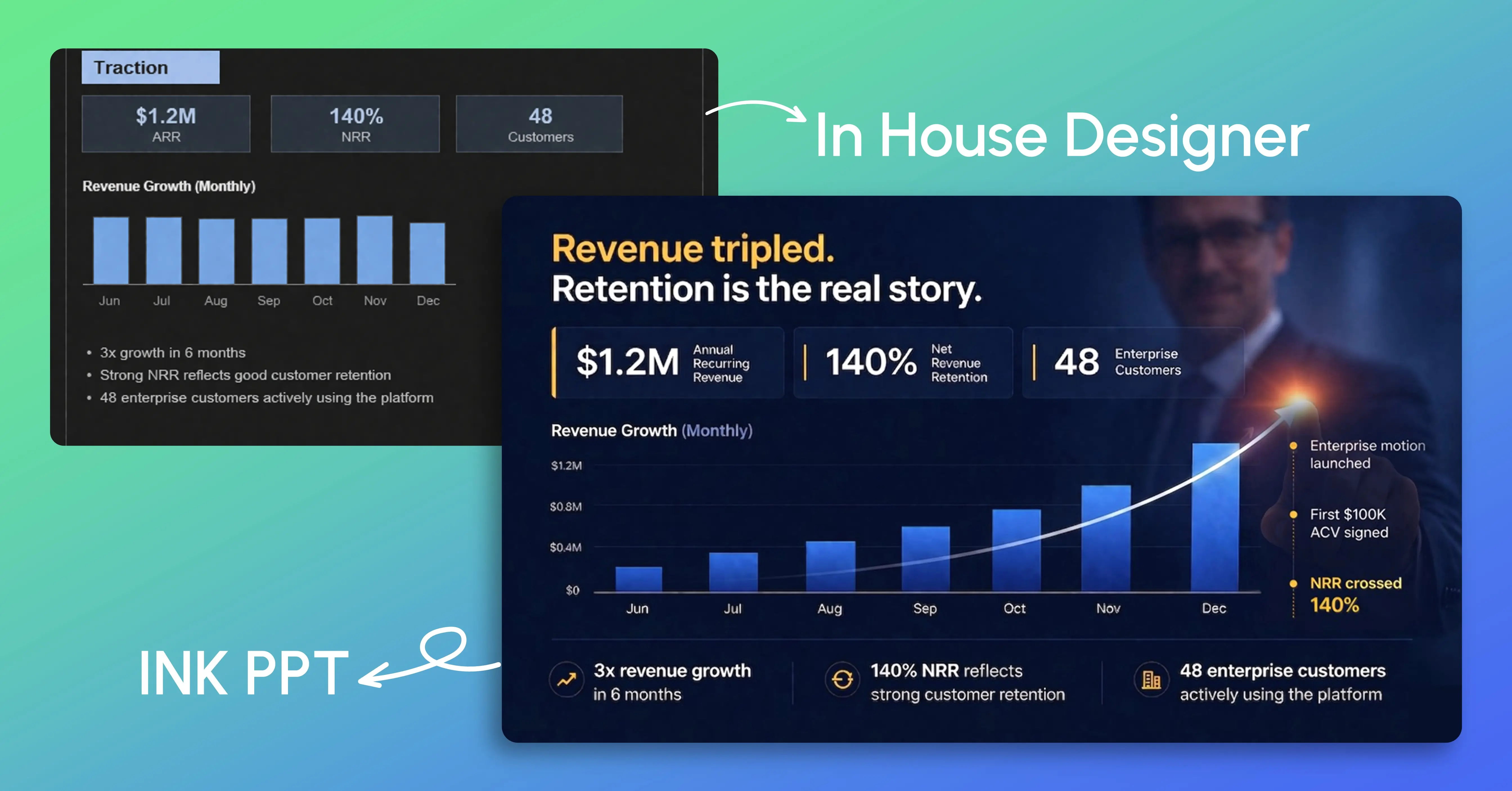
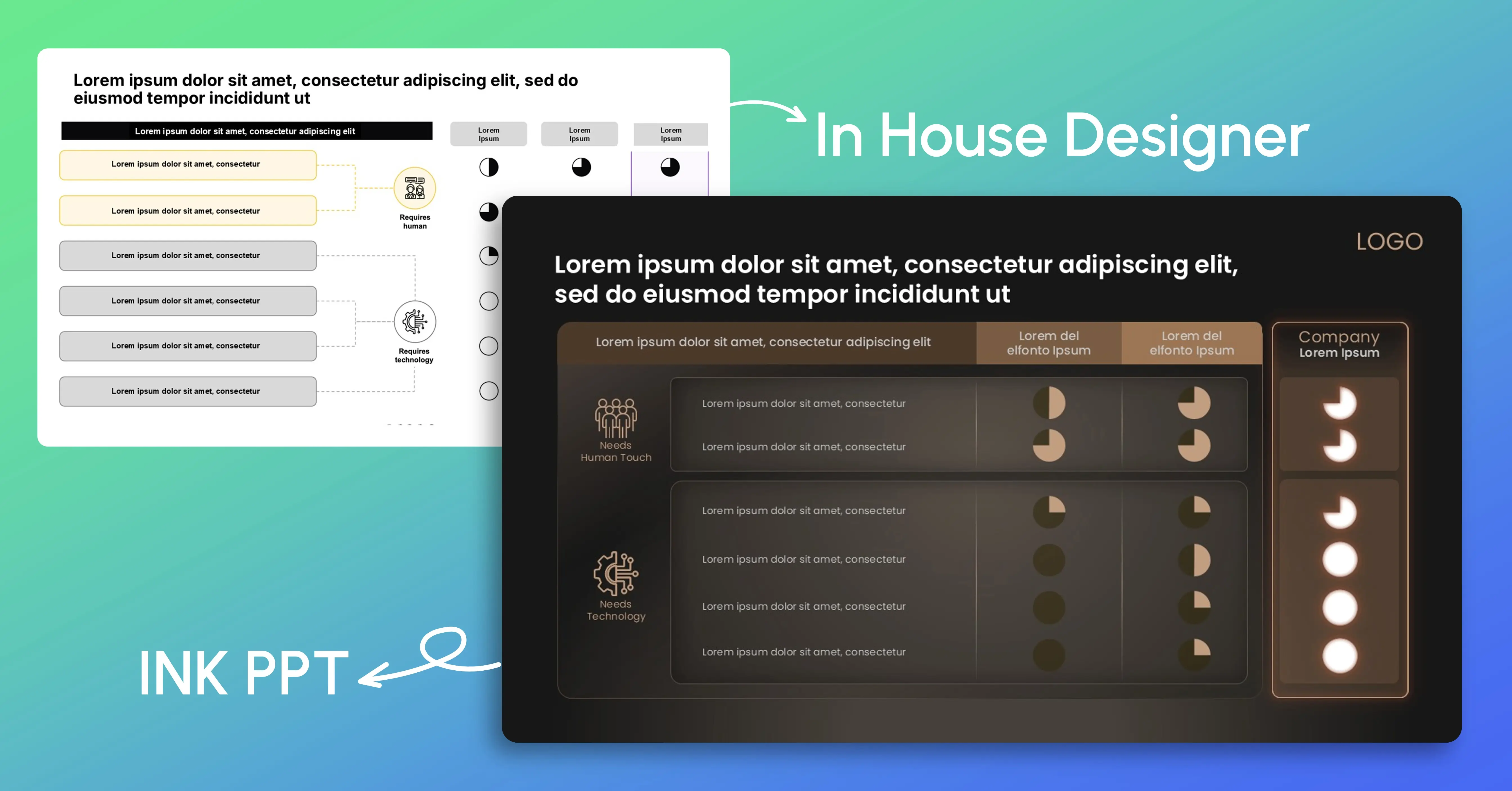
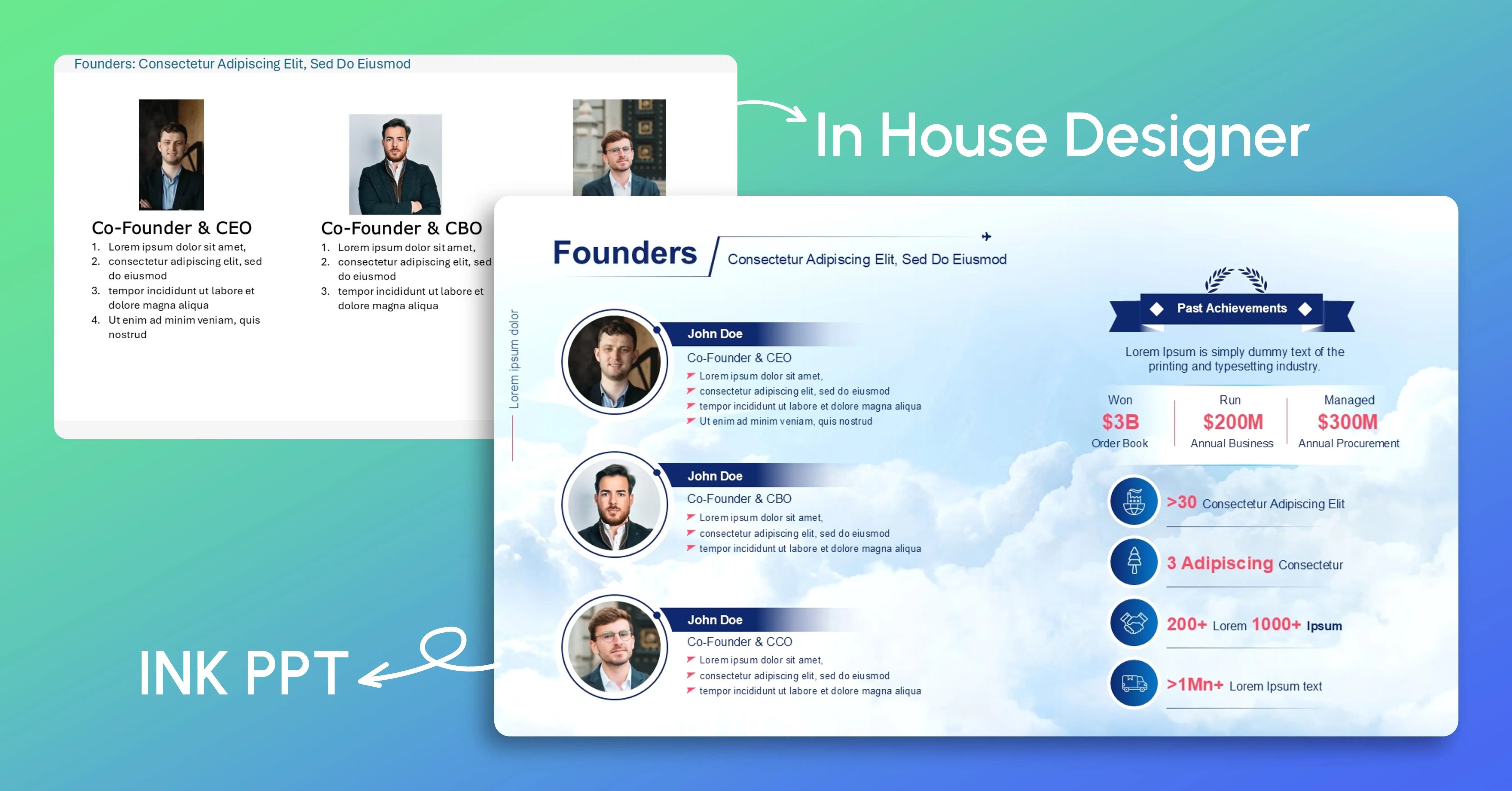
The gap is not about visual taste or production polish. It is about whether the design is doing active persuasive work on every slide, reducing friction, directing attention, and answering the investor's questions before they are asked aloud.
The Aditya Birla Capital Day presentation demonstrates how professional presentation design generates business value through its complete design which extends beyond visual appeal. The project required 8 days to complete because INK PPT provided design and revision services which operated continuously throughout the entire time. The project development team included 2 core members who created 35 custom slides while performing quick review processes and stakeholder alignment work and brand consistency maintenance work under pressure. We solved this by building a modular, animation-ready slide system that enabled faster updates, clearer storytelling, and more polished leadership communication. The presentation was developed to achieve two objectives which included creating an aesthetic appearance and making complex business information accessible to understanding and implementation.
Need a presentation that does more than look polished? INK PPT helps turn complex business stories into clear, high-impact decks built for leadership, investors, and enterprise audiences.
The reason why certain decks were able to attract funding follows certain logical considerations. This may be illustrated by the seed deck created by Airbnb, which has received wide acclaim for its ability to generate financing through the use of an elegant presentation design—10 slides, 1 idea per slide, and precise wording to address investor risks.
Y Combinator's pitching model, which has been commonly adopted by startups for their fundraising purposes, represents more of a design philosophy than the template itself. The fact that each slide must convey one idea can be viewed as a constraint on the design side. The more successful the company, the more likely that all slides are designed to serve one purpose.
When it comes to designing successful decks, what sets apart successful decks from the others is the handling of uncertainty. It is worth noting that investors invest in risks they don't invest in certainty. The presentation designs of professionally created decks recognize uncertainties graphically by using projections ranges, risk scenarios instead of risk free decks, competitive maps that identify vulnerabilities. These aspects of presentation design represent what high tier VCs mean by 'sharp' founders.
Not every presentation justifies a full PowerPoint design agency engagement. Here is a framework to make that decision clearly:
Most hiring decisions for presentation design are made on portfolio aesthetics. That is the least reliable signal. The agencies and designers who produce the most business impact are distinguished by something different.
A Note on Cost: Professional engagement in designing a pitch deck varies between $2,000 for an optimized redesign up to $50,000 for an entire strategy deck development at a firm like Pitchdeck, which has produced more than 10,000 decks and helped raise more than $100 billion. The calculation is quite straightforward: how much does an extra investor meeting cost you during your round? Each meeting during a typical Series A raise translates to millions in your deal flow. This is no mere line item; this is leverage.
ROI on professional presentation design is not limited to a single deck. Each quality presentation generated by your company becomes part of your institutional assets.
When your investor deck is professionally designed, the logic, visual language, and data structure of the deck become the starting point of your board deck, sales pitch, executive briefing, and even your internal communications. Companies which invest in one well-designed presentation deck generate leverage with each communication effort.
Companies that produce ad hoc decks, which are created by whoever is able, have to pay a price for such an approach. Every wrong font choice, incorrect alignment, non-compliance with color rules in the deck is a subtle message to sophisticated observers that you do not pay enough attention to details.
In today's environment when standing out from the crowd and attracting attention is very difficult, presentation design quality becomes a competitive lever. It sends the clear message that executives and investors are not only interested in what you are communicating but also in the way you do it.
For example, imagine a Series A funding round for a B2B SaaS platform. The founders had excellent metrics: $1.2M ARR, 140% net revenue retention, and a defined enterprise sales process. They made two decks and decided which one they would use in their investor meetings.
The difference between 4 meetings and 11 meetings from identical outreach is not the business ,it is how the business was presented. The professionally designed deck made the same metrics feel more credible, more memorable, and more worth a conversation.
There is an underlying design principle in the decks that raise the most money that goes beyond simply aesthetics. Airbnb’s seed presentation, frequently hailed as iconic, was successful in that it was ruthlessly simple, 10 slides, one point per slide, every word carefully selected for its ability to mitigate risk in the eyes of investors. The presentation wasn’t about looking impressive; it was about removing barriers to a yes.
Y Combinator’s format, popularized by Sequoia Capital and still used frequently by startups to this day, is the product of a design philosophy masquerading as a framework. By requiring that each slide only have one clear idea in it, Sequoia created a design constraint as much as anything else. Successful presentations always have a single idea per slide, and that idea is clearly communicated in 3 seconds.
In professional decks, there is a certain handling of uncertainty that distinguishes them from non-professionally designed presentations. Uncertainty is the enemy of funding: investors do not bet on things that are predictable. Uncertainty should be reflected visually, in decks, in ranges versus projected numbers, risk slides that are upfront instead of buried, competitive maps that identify weaknesses as well as strengths. When high-tier VCs talk about sharp founders, they mean the founder can see where the uncertainties lie strategically, not verbally explain them in a 20 minute pitch.
Not every presentation justifies a full agency engagement. Here is a framework to make that decision clearly:
Most decisions about presentation design hire are made based on portfolio aesthetics. This is the least reliable indicator. Those agencies and individuals who have made the biggest difference to the business use an entirely different approach.
A Note on Cost: The Professional pitch deck design services which agencies provide to their clients start at a cost of $2000 for basic design work and reach a maximum price of $50000 for complete development of strategic presentation materials at Pitchdeck which has developed more than 10000 business presentations and helped clients raise over 100 billion dollars.
The ROI on professional presentation design is not confined to a single deck. Your company establishes a permanent asset base through every exceptional presentation that it develops. Your investor deck achieves its professional design standard when its logical structure and visual elements and data framework develop into your board deck and sales narrative and executive briefing materials and internal communications. Companies that invest in one well-designed presentation system gain leverage across every communication moment.
The reverse is also true. Companies that build presentations ad hoc, whoever has bandwidth creates the deck, end up with a fragmented visual identity that slowly erodes stakeholder confidence. The audience receives a message about the organizational culture through every different font selection and every table that does not match and every presentation that uses colors incorrectly. The reverse is also true. In markets where companies compete for customer attention through various unique offerings, presentation quality functions as a market differentiation factor. The presentation shows that business leaders take their communication work seriously, which indicates they will deliver serious execution results.
INK PPT works with CXOs, marketing leaders, and founders who cannot afford for a presentation to underperform. Our team combines design expertise with strategic narrative thinking, so every deck we build earns its place in a high-stakes conversation.
We have built presentations for Fortune 500 leadership teams, investor roadshows, global summits, and enterprise sales cycles. The work is always specific: to your audience, your moment, and the outcome you need.
As a passionate explorer, I see crafting the perfect story as embarking on a refreshing Himalayan journey. Every narrative is an adventure, a voyage of imagination, meticulously molded into captivating presentations. I'm here to guide you, ensuring your story becomes an unforgettable odyssey, with each creation as a vibrant landscape ready to captivate eager audiences.

About the Author




Consult with our Business Advisor


