High-stakes presentations often underperform not because the content is weak, but because the process that built them was wrong from the start. Internal teams face structural limits with proximity bias, hierarchy tax, and cognitive overload, which a disciplined external partner is built to remove. This piece explains why the most consequential decks in any organisation deserve a fundamentally different process, and what that process actually looks like.
The Silence After the Meeting
There is a certain type of silence that occurs after an important meeting in which the key stakeholder failed to be impressed. This type of silence does not occur when there is some tension between the people in the room. No, this type of silence comes after a meeting during which nothing gets decided – but everyone knows that there will be no decision to get made.
A medium-sized FMCG company sent its CMO out to develop a ₹40 crore brand investment strategy. They used external research. They had all the data they needed. They had an exciting story to tell. And at the end of the day, the leadership team simply thanked him, told him that they would get back to him, and two weeks later, decided to "hold off for now."
The problem wasn't in the content; instead, it was in the deck's presentation framework.
This particular deck had been built much like many others: a senior leader would put together his or her ideas, pass them onto the person "good at PowerPoint" rather than to a top-notch professional presentation design agency, go through three rounds of editing via WhatsApp, and present to the team at 2 am. As a result, the deck was just another strong idea that lacked a solid framework to deliver it effectively.
01. The Stakes Have Changed. The Process Hasn’t.
The majority of organisations use a structured approach to everything, from legal to financial to creative approval and production processes. The only thing that does not change, along with the stakes, is the process behind the creation of high-stakes decks. While everything else in your organisation grows increasingly structured, presentations remain a quick and chaotic experience – with an external design agency left out of the picture.
In order to build a successful presentation framework for your company, you have to understand one critical truth: it will only work when presented successfully to the right stakeholders. This means you must work with the best presentation design agencies available to you to create a presentation framework that would work in any boardroom.
PRESENTATION TYPE
COST OF A WEAK DECK
Internal team update
Confusion, follow-up email needed
Quarterly business review
Delays, clarifying questions
Board or investor pitch
Eroded trust, lost funding
Global client RFP
Deal moves to a competitor
CEO keynote/product launch
Brand perception damage
Government tender/procurement
Disqualified on capability read
There is no tolerance for ambiguity in the room. When millions of rupees worth of funding or a game-changing partnership is at stake, ambiguity cannot be shrugged off as an innocent mistake or an unfortunate accident. It will be taken as a red flag. And even if the audience doesn’t explicitly state that confusing slides made them question the value of the proposal, they won’t need to say anything at all. We’ll know by looking at their faces.
02. Why Internal Teams Hit a Ceiling
The ceiling isn’t a reflection of skill or ability; it is a limitation imposed by the internal process itself. Internal designers are very often highly skilled individuals. However, they are constrained by limitations of the process that they have no power to change.
The Four Structural Limits of In-House Production
1. Proximity Bias: They can’t unsee what they know
Internal teams operate within the framework they know best – the framework of organisational language, legacy slides, and assumptions about context that are second nature. This is precisely why the most forward-thinking companies, particularly those working with a presentation design agency in India, choose partners who bring a genuinely outside perspective: someone who sees the deck exactly as the audience will, without the baggage of internal context.
2. The Hierarchy Tax: No one will tell the SVP that the slide is killing the deck
Every internal team experiences this challenge. There’s always at least one slide in the presentation that an internal designer cannot touch. Whether it’s the SVP’s favourite slide or just one with a piece of data that is too close to the person’s heart, an internal designer won’t touch it for fear of conflict. An external partner would simply remove it, but they are answerable to the argument alone, not to internal politics.
3. Context Blindness: Selling features when the audience is buying outcomes
An internal designer knows everything there is to know about the organisation. They know its history, its values, its strengths, and its weaknesses. They can create a story about how everything works, but not necessarily about what the audience wants to hear. In-house teams focus on what has been created, while external partners focus on what the audience is trying to achieve.
4. Cognitive Bandwidth: A Series B pitch is not a side task
Ask a designer to produce slides all day while creating a high-risk pitch deck and you will inevitably end up with a sub-par pitch deck and a sub-par day-to-day production work. The value of bringing a top professional PowerPoint design agency on board lies precisely in their team's ability to give 100% of their cognitive focus to every step of this complex process, from structure and storytelling architecture all the way to the final QA without getting sidetracked by the responsibility to manage campaigns and weekly reports on the side.
“But what I liked most about them is their ability to understand the brief and convert it into a compelling story. In fact, I call Aayush, the founder of INK PPT, a storyteller.” — Marketing Director, Samsung
03. What “Getting It Right” Actually Looks Like
While the key to closing a deal with a high-level presentation rarely has anything to do with its content, everything depends on its structure. And here is how that difference looks in practice.
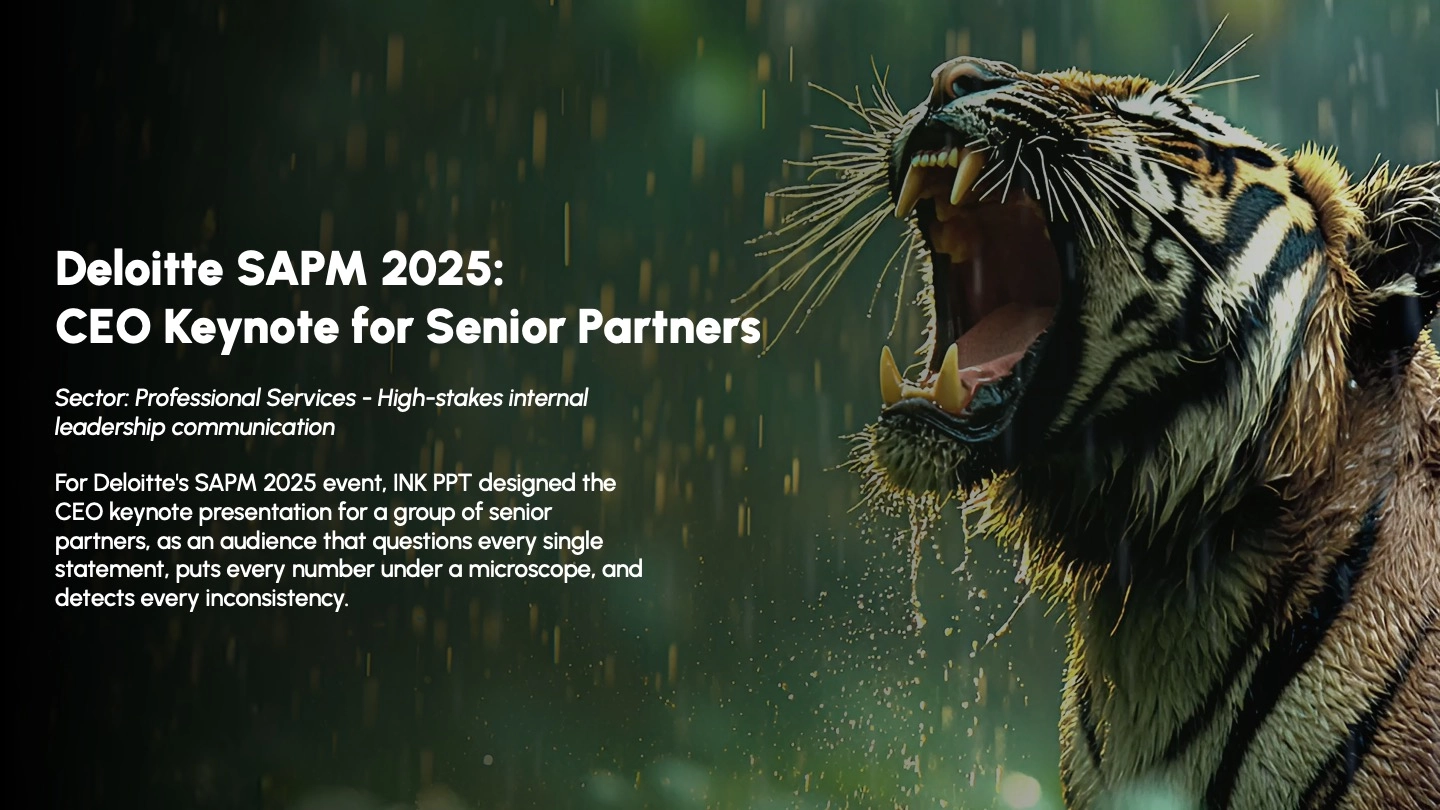
Deloitte SAPM 2025: CEO Keynote for Senior Partners
Sector: Professional Services - High-stakes internal leadership communication
For Deloitte's SAPM 2025 event, INK PPT designed the CEO keynote presentation for a group of senior partners, as an audience that questions every single statement, puts every number under a microscope, and detects every inconsistency.
The challenge
High level of scrutiny coming from a senior internal audience. A 17K+ multi-screen environment in which every visual element would be under scrutiny. The necessity to gain trust rather than just impress.
The approach
Structured typography, data hierarchy, and visual narrative to guide the viewer's attention
Applied a tiger-themed narrative as a tool to structure the presentation, not to embellish it.
Created each individual slide in the context of the entire presentation argument.
The outcome
A 90-minute keynote presentation capturing and holds its audience without any distractions.
A successful presentation because of a well-structured, coherent argument.
Very diverse audience with leaders from 390+ hotels spread across 4 continents. The same story would need to work with both operations-led and brand-focused audiences. Presentations such as these are precisely why a PowerPoint Presentation Design Company gets its chance to shine, one with the capability of telling a single story thread in radically different contexts, without losing any strategic and practical relevance.
The approach
Developed the presentation based on one belief we wanted all the leaders to take away.
Created two presentations linked through a theme: one focused on strategy direction, the other on business unit details.
Gave a non-linear navigation structure that enabled presenters to go off the book yet stay in sync with the narrative.
The outcome
A presentation system built not just for the keynote, but for continued use afterward
Slides designed to stay relevant in team briefings and regional discussions long after the event ended
04. The Process That Changes the Output: INK PPT’s 5D Framework
Most PowerPoint design agencies start with a template and begin their process with template creation. This methodology assumes 'the look' comes first. But every flaw in that deck can be traced back to the order of those assumptions.
At INK PPT, no PowerPoint deck goes under the designer’s knife until the narrative is sorted out. This isn’t a promise. It's an operational necessity that impacts every decision made thereafter.
THE 5D STAGE
WHAT IT ACTUALLY DOES
Discover
We don't only audit the brief. We understand what win conditions look like for this presentation. We also understand what the audience believes now and what we want them to believe by the time the deck ends. In addition, we know one thing: What is the single question that the presentation needs to answer?
Define
We build the narrative logic first. We map the stakeholders’ psychology. We define the persuasive logic of the presentation, then we kill everything else - even the favorite slide of a senior leader.
Develop
This is where the structure of the presentation begins to form. All the logical flow of the deck is tested and optimized as a pure logic document first. This way we make sure that if it doesn't work here, it won't work anywhere.
Design
Visual representation of a well-formulated argument. Typography, visual hierarchy, data presentation, and white space all have a particular purpose in building an irrefutable case.
Deliver
We don't stop after 'Save as'. We roll out the deck, train the presenter, and make sure it works regardless of context - whether live in the room, emailed, shared via phone screens or referenced in a follow-up discussion you're not party to.
05. The Pre-Send Test: Does Your Deck Survive All Three Rooms?
All high-stakes decks cater to three rooms, not just one. All but a few decks are designed for the first one only.
THE ROOM
WHAT IS YOUR DECK FACING
Room 1: The Live Room
You are in the room. You’re narrating, reading the audience, and answering the CFO’s question before it derailed the entire meeting. Great delivery can cover up an ineffective slide.
Room 2: The Forward
There are two people who didn’t attend the meeting and got the deck sent to their email addresses. They opened it late at night (on their phone, no less) with no context and without knowing what you presented before.
Room 3: The Quiet Room
48-72 hours after the meeting, in a completely new meeting you haven’t been invited to, someone brings up the deck to ask, “What do we need to do?” If the answer isn’t on slide one, you’ve already failed.
Before any high-stakes deck is submitted, run it through this checklist:
Does slide one state the recommendation? (Room 3 test: can it close without you?)
Does every chart title deliver a verdict, not a topic label?
Can a stakeholder who was not in the meeting follow the full argument?
Is the deck readable on a phone screen?
Does each headline pass the Forwarding Test or does it make sense out of context?
Do you have a separate leave-behind version for Rooms 2 and 3?
Is every animation purposeful, with a brief? Or is it decoration?
Is there a single, clear ask on the final slide?
The rule most teams ignore
The live deck and leave-behind are different documents. They address different audiences. To give the leave-behind the job of the live deck means that you’re essentially giving speaker notes instead of a report. Any PPT design agency with standards should design both documents, using the same visual language but different information densities.
06. What to Look for in a Presentation Partner (And What to Avoid)
It goes without saying that not every agency that delivers great-looking slides can be considered a partner for your presentations. But here is the crucial distinction that differentiates the two:
WHAT A REAL PARTNER DOES
WHY IT MATTERS
They ask about the audience before they ask for the brief
Agencies in formatting mode want to see your current deck first. Partners ask who your audience is and what their current stance is on your project.
They push back on your content
A true partner identifies weaknesses, reduces redundancies, and questions everything, including the slides that your CEO loves so much.
They think like business people who design
It’s not just a pretty document that you get in return. It’s a tool for decision making. And every design choice has to be linked to a business objective.
They have a process, not just a portfolio
Pretty slides are simple to present. What truly counts when it comes to high-stakes presentations is an efficient process that is applied under 48-hour time constraints.
They deliver two formats
A live deck and leave-behind version are prepared separately from one another. Because they know which rooms they are going to speak in.
At Last
To sum it up, a high-stakes presentation agency is a critical bridge between solid strategy and success. In front of key decision-makers, you don’t just communicate data, you prove the quality of your professionalism. You cannot entrust such an important mission to an ad hoc, rushed process.
At INK PPT, we are convinced that each of your slides has to represent your company’s business logic. Only by treating your decks as strategic assets will you secure the “trust shortcut” required to succeed in highly competitive environments. No matter if it’s a fundraising or international tender process, the gap between “nice enough” and “awe-inspiring” presentation lies in the methodology.
Stop gambling on high-stakes moments. Partner with us to transform your strategy into a commanding visual narrative that wins. Secure your next big deal with an airtight, professional presentation.
“Nobody budgets for a bad presentation. But everyone pays for one.” — Aayush Jain, MVP & Founder of INKPPT
“Ready to Win Your Next Big Deal?”
If your presentation needs to do more than inform to build trust, command attention, and drive decisions, INK PPT can help you turn strategy into a winning narrative.
When should I consider hiring a presentation agency vs using my internal team?
If you are doing regular communication, weekly updates, internal presentations, and routine QBRs, then you probably don't need an outside partner. Work with your internal team for those projects. However, if the stakes are so high that a bad deck in this room could be costly, then the process needs to match the level of the stakes.
Won't we lose control of our brand identity if we work with a specialist?
A professional partner will start their process by conducting a brand audit – going through existing brand guidelines, past presentations, and examples of tone of voice and design style. Maintaining a consistent brand identity is not a matter of experience; it's a matter of process. The same diligence required to build a strong argument can ensure consistency throughout the design. For most of INK PPT's engagements, all brand integrity is achieved in the very first draft.
What's the real ROI of getting my presentation done right?
The answer lies in determining how much value the presentation is expected to generate. An investment of ₹5 crore in a presentation that helps close deals for a ₹40 crore deal is not actually an expenditure. Rather, it's an ROI of 700%. The better question would be what's the price of a bad presentation in an environment where the stakes cannot be revisited? Most companies don't ever figure that out until after the fact.
What happens if we need to make changes at the last minute?
A high-stakes timeline is no outlier. It is simply a regularity. And INK PPT's 5D process is built in such a way as to be resilient against pressure since it solves for narrative logic before designing. Late-stage changes to content don't necessitate rebuilding the structure. Moreover, our proprietary design systems ensure that late changes can be made without violating visual continuity. Finally, for urgent jobs, QA runs at each stage, not just upon delivery.
How is a high-stakes presentation different from a standard one?
Not in the budget allocated for design. It's the risk of being unclear. With standard presentations, the audience might ask a question when they get confused. However, in a high-stakes environment, confusion could hurt trust. And once that trust is gone, it's not easy to get back in a boardroom or international RFP. This is precisely why leading brands go for the best PowerPoint design agency whenever it matters.
Need a Presentation That Stands Out? We’ve Worked with Industry Giants and Assure Results That Command Attention !
Co-founder of INKPPT, I specialize in transforming complex ideas into refined, visually striking presentations. With a deep belief in the power of storytelling and design, I help brands communicate with clarity, purpose, and impact. Every slide is crafted to inform, inspire, and leave a lasting impression.

.webp)